
Age of Babylonian Kings

If you’ve wondered why Genesis 5 describes men who lived hundreds of years, I might be able to explain.

It’s not what you think.

First, it’s not a “x10” issue. That’s silly. Seth wasn’t 10 years old when he had his son Enosh. Enoch wasn’t 6 years old when he had Methuselah. It’s not a math problem.

Second, it’s not a “copy” of the Sumerian, Akkadian, or Babylonian kings, who lived 36,000 years according to their stories. Those kings were god-men, and their kingdoms were glorified. There is no such veneration in Genesis 5.

So what is going on? Why does it seem a little similar to the ancient Mesopotamian stories?

The way to study this is to think less about the characters in the story, and think more about the intended audience of the story.

It is largely assumed that Genesis was written/compiled/edited during a very important time in Jewish history: the Babylonian Exile. It is for this reason that so much of Genesis has such strong anti-Empire undertones. Even the creation account kicks against the Babylonian pantheon, with Tiamat an entire non-participant in the story in the first few verses.

The Tower of Babel, too, is a dig at the expansive Babylonian Empire.

So what of the long-lived kings?

The Genesis 5 account doesn’t show the men as being holy or powerful. It gives almost no attention to their accomplishments, and saves precious few words of elevation for Enoch and Noah. But the big kicker is found in Genesis 6.

In Genesis 6 we learn that the ultimate culmination of this list of long-loved men is… wickedness. Total darkness. It’s so bad that God is grieved at how humanity has imploded. Only a flood will do.

This is a statement about humanity, but more pointedly, it’s a statement about Babylon, which has enslaved the Jewish people. They are a symbol of wickedness.

The flood isn’t God’s anger at humanity. It’s God’s promise of deliverance. He will destroy the Babylonian empire and rescue his people.

So, like many other aspects of Genesis, the story of long-lived men is thumbing the nose at Babylon, teaching us to always thumb our noses at Empire.
Male and Female

This is the book of the generations of Adam. On the day when God created man, He made him in the likeness of God. He created them male and female, and He blessed them and named them “mankind” on the day when they were created.
Genesis 5:1-2 (NASB)

The genealogy in Genesis 5 lists men being born, having children, and dying.

“Where are the mothers?” one of my students asked me.

It’s a fascinating question. Why does the text highlight the men, and not the women? Perhaps it’s because nobody asks a woman if she is the legitimate parent. Everybody knows she is, whereas the men are suspect. A statement must be made and then trusted.

But for those who might wonder if the text simply favors men and disregards women, the first two verse ensure that we have men and women in view from the beginning. Male and female, in the likeness of God. All of us. None are ignored or forgotten.

Adam’s Redemption

This is the book of the genealogy of Adam. In the day that God created man, He made him in the likeness of God. He created them male and female, and blessed them and called them Mankind in the day they were created. And Adam lived one hundred and thirty years, and begot a son in his own likeness, after his image, and named him Seth. After he begot Seth, the days of Adam were eight hundred years; and he had sons and daughters. So all the days that Adam lived were nine hundred and thirty years; and he died.
Genesis 5:1-5 (NKJV)

Perhaps the story of Adam’s redemption is found in Genesis 5, verses 1-5.

You’re on the Boat

If you read the Bible and you don’t know God loves you with the greatest love, the words will sound like hell.

You’re going to see yourself cast out of the garden.
Marked for death.
A random name in a list of names.
Left off the boat as the flood rises.

But that’s not the story.

He left the garden with you.
He shielded you from vengeance.
He knows your name.
He carries you in the boat.

It is your story. It is the story of His great love for you.

A Very Specific Date

In the six hundredth year of Noah’s life, on the seventeenth day of the second month—on that day all the springs of the great deep burst forth, and the floodgates of the heavens were opened.
Genesis 7:11 (NIV)

I find it interesting that after discussions about “approximate years” and “outrageous ages” of the men listed in the genealogy of Genesis 5 (suggesting that the dates are vague approximations or merely symbols of “very long times”), we are presented with this extremely specific day of the flood.

Comments on Commentary

Some rabbis have suggested that the Genesis 5:3 statement that Seth was in “Adam’s likeness: hints at Genesis 6’s world of weird angel/hybrid creatures.

Adam himself is TECHNICALLY not “just a human,” being born of dirt and spirit.

ויולד בדמותו כצלמו, “he begot a son in his likeness in his image;” the emphasis on this is to show us that anything he begot during the previous 129 years were only creatures that did not reflect his likeness or image, i.e. disembodied spirits, mostly מזיקים, injurious, destructive spirits. (Compare 3,20)
Chizkuni on Genesis 5:3

BUT.

Other rabbis in the Midrash have said that being “in Adam’s likeness” meant that he was… born circumcised.

He was righteous (Gen. 6:9). This suggests that he was one of the seven men born circumcised. Adam and his son Seth were born circumcised, as it is written: He begot a son in his own likeness after his image, and he called him Seth (Gen. 5:3).
Midrash Tanchuma on Genesis 5:3

Which is, by the way, NOT ANY WEIRDER THAN ANGEL/HUMAN MONSTER BABIES.

So, always take commentary with a grain of salt. Even mine.

Patterns in the Ages

Genesis is full of patterns that are intended to draw your attention; breaks in the repetition should make you stop and ask, “Why?”

Genesis 5 lists the ages in the generations between Adam and Noah, and a few stand out. The youngest, the oldest, and the one with the strange number.

Methuselah lived the longest – 969 years. His name is linked to his long life, which was not just for his benefit, but for the benefit of humanity as God restrained the Flood until after Methuselah died.

Enoch notably never died.

And Lamech? He shares a name with a notable man in Cain’s genealogy. Cain’s Lamech is man of seventy-seven-fold vengeance. But the Lamech of Genesis 5 goes down a different path. Not one of vengeance, but of Comfort.

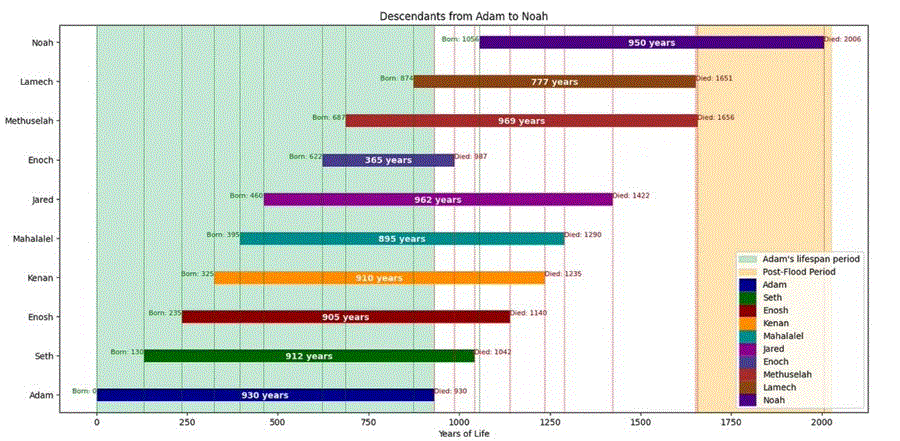
From Adam to Noah (Visualized)

It’s interesting to see the ages of the patriarchs graphed out. If we read Genesis 5 literally, Adam lived to see Noah’s father born.

I suppose the blessing here is that during Adam’s life, he does not see any of the promised lineage below him die. Not to say that nobody died (Cain did kill Abel, after all), but nobody in this specific genealogy dies before Adam.

Maybe that’s a story of hope.