
Abraham Came to Mourn

Sarah died in Kiriath-arba (that is, Hebron) in the land of Canaan; and Abraham came in to mourn for Sarah and to weep for her.
Genesis 23:2 (NASB)

In the Hebrew, it’s וַיָּבֹא֙ (vayavo) which means movement from one place to another. It appears that the text tells us Sarah’s location because Abraham was not there when she died.

So where was he?

Perhaps the Binding of Isaac in the previous chapter isn’t merely a story about a man who is asked to sacrifice his son, but also a story about a man who loses his wife while being obedient to God.

A son loses his mother in the same way.

What is the cost of obedience?
The Terror of Death

Then Abraham arose from mourning before his dead, and spoke to the sons of Heth, saying, “I am a stranger and a foreign resident among you; give me a burial site among you so that I may bury my dead out of my sight.”
Genesis 23:3-4 (NASB)

There are layers to scripture. Genesis 23 contains a long text about Abraham seeking a burial site for Sarah. It’s not just a story about negotiating over a plot of land.

Heth is the son of Canaan, son of Ham.

Heth means “terror.

This is a story about dealing with the terror and agony of death.

Years of Sarah

Back in Genesis 5, I pointed out that the way the years of each pre-flood patriarch is written is fascinating based on the 10s and 100s. For example, Genesis 5:17 says the years of Mahalalel were “5 and 90 years, and 800 years.” 1s-and-10s, followed by 100s.

But Adam’s are reversed: 100s, and then 10s.

The rabbis suggest that when the years are in “standard” form (“Methuselah lived 6-and-90 years, and 900 years”), this is NOT noteworthy. But when it’s reversed, it means the latter years were more productive. Perhaps closer to God.

“Adam lived 900 years, and 30 years.”

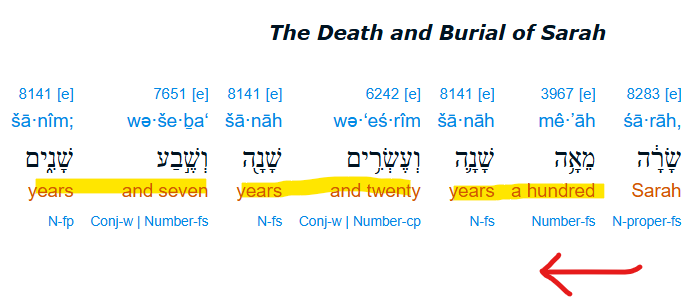
Before we learn that Sarah dies in Genesis 23, the reader should be in awe at the way her years are written in Hebrew:

“Sarah, 100 years, and 20 years, and 7 years.”

This outlay of years can be seen as a whole story of an increasing intensity and closeness to God.

Separating

Genesis 1 and 2 show us God creating through a process of separating: light from dark, land from water, Isha from Ish. I think the pattern here in Genesis 15 is related.

Here, it’s Abram who cleaves the animals. We might agree that this is a destructive act, rather than a creative one. However, we see that God dwells even in those separations, shown as a torch that passes between them. It’s quite powerful imagery: God in the spaces between.

I like to think that God healed those animals that were cleaved, and He brought them back to life so Abram could see that God is Lord over death and life as well.

Even in Death

As for you, you shall go to your fathers in peace; you will be buried at a good old age.
Genesis 15:15 (NASB)

The English renders the Hebrew word “bo” here as “go,” and it makes the place of the dead seem far away, like a distant place to arrive after a long journey through life.

But the rabbis say this word more often means “come.” As in, even in death there is nearness to God.

Sleep and Darkness

As the sun was setting, Abram fell into a deep sleep, and a thick and dreadful darkness came over him.
Genesis 15:12 (NIV)

The rabbis say that sleep is a microcosm of death. How would Adam have known to fear death until he was terrorized with unnatural sleep?

And here in Genesis 15, we see it plainly. Darkness hasn’t been mentioned since Genesis 1. This is an echo of Genesis 2.

You’re on the Boat

If you read the Bible and you don’t know God loves you with the greatest love, the words will sound like hell.

You’re going to see yourself cast out of the garden.
Marked for death.
A random name in a list of names.
Left off the boat as the flood rises.

But that’s not the story.

He left the garden with you.
He shielded you from vengeance.
He knows your name.
He carries you in the boat.

It is your story. It is the story of His great love for you.